
Notting Hill House Renovation
Van Peake carries out house renovations in Notting Hill and across the rest of London, from single rooms and one-floor projects through to a house taken back to brick and rebuilt. A full renovation in W11 typically runs £150,000 to £750,000, and partial work costs considerably less. What follows is what the work involves, what one costs, how long it takes, which consents RBKC actually requires, and the things people tend to find out too late.
The photographs are from a house we renovated in Notting Hill. It began with a dig-out at lower ground floor level and ran up through the whole house, from a new kitchen at the bottom to a roof terrace at the top, with a floating glass staircase carrying daylight down into the level that had just been excavated.
What the project involved
The lower ground floor was excavated first. That is the part of the work that changed what the house could do, and everything else was arranged around it.
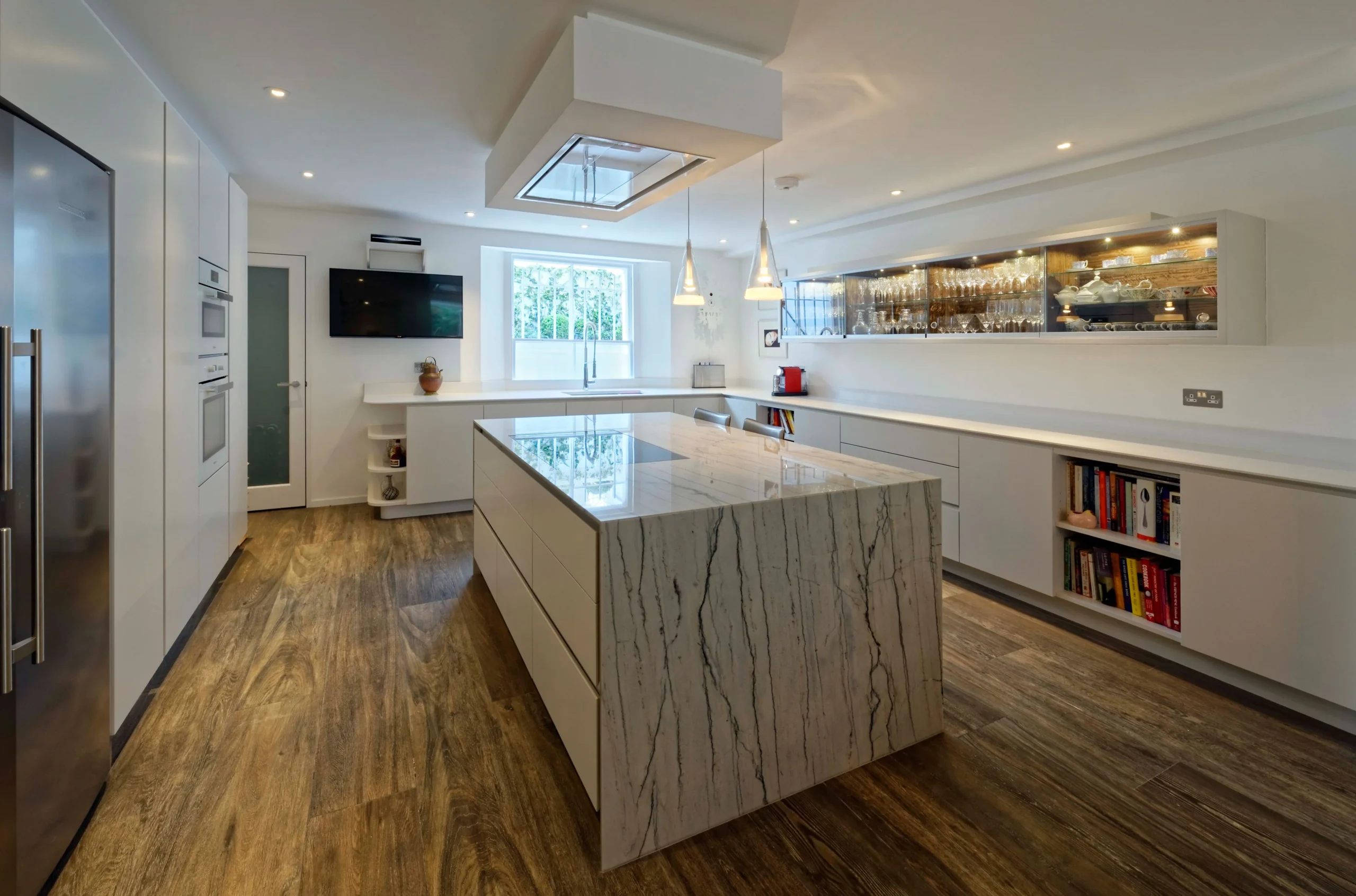
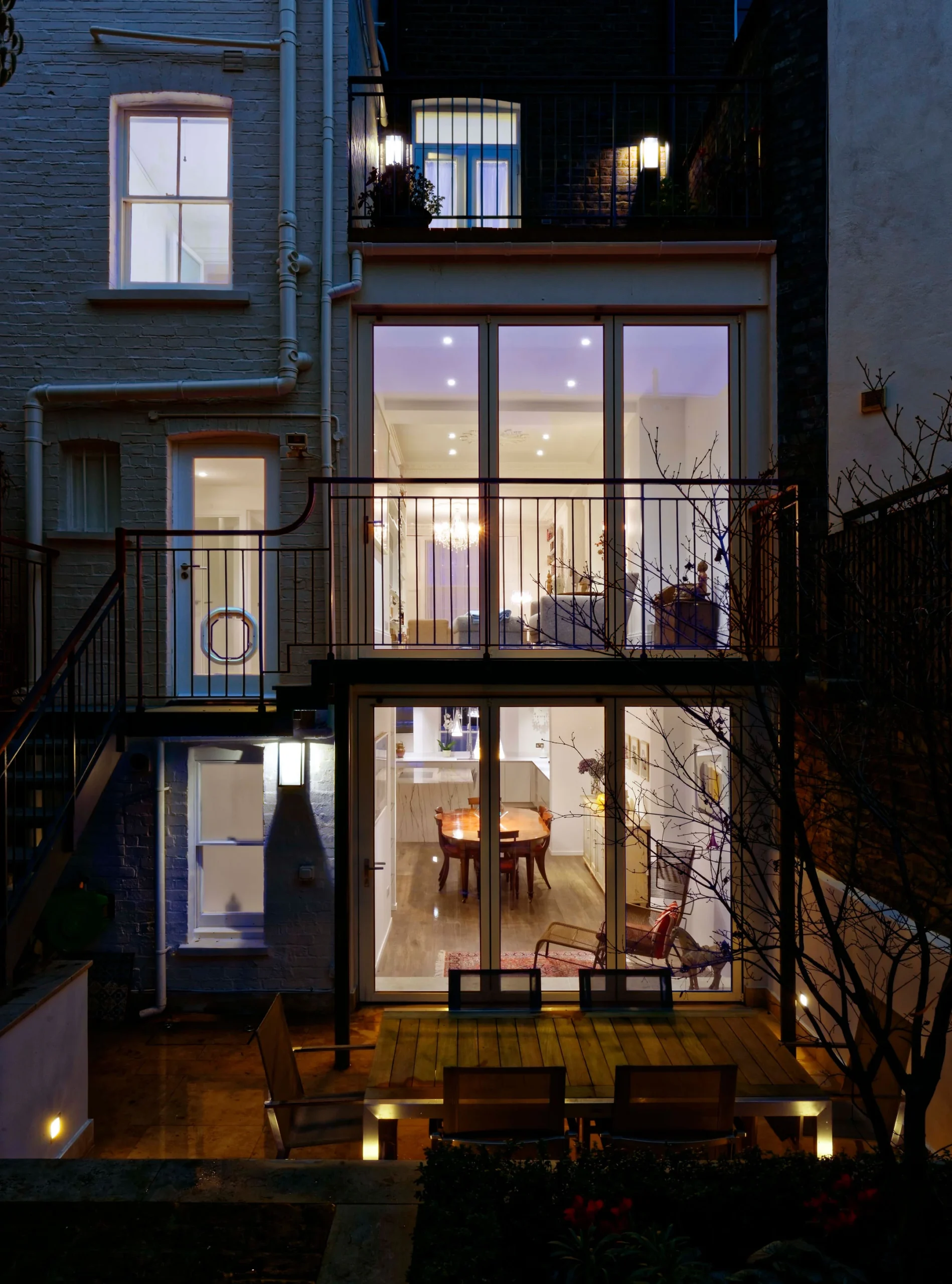
The kitchen sits on that new level. Units are handleless and full height, the island is stone with waterfall ends carried down to the floor, and a run of glazed cabinetry is lit from inside along one wall. A rooflight is set into a dropped ceiling directly over the island, so the surface you work on is under daylight rather than under a downlight.
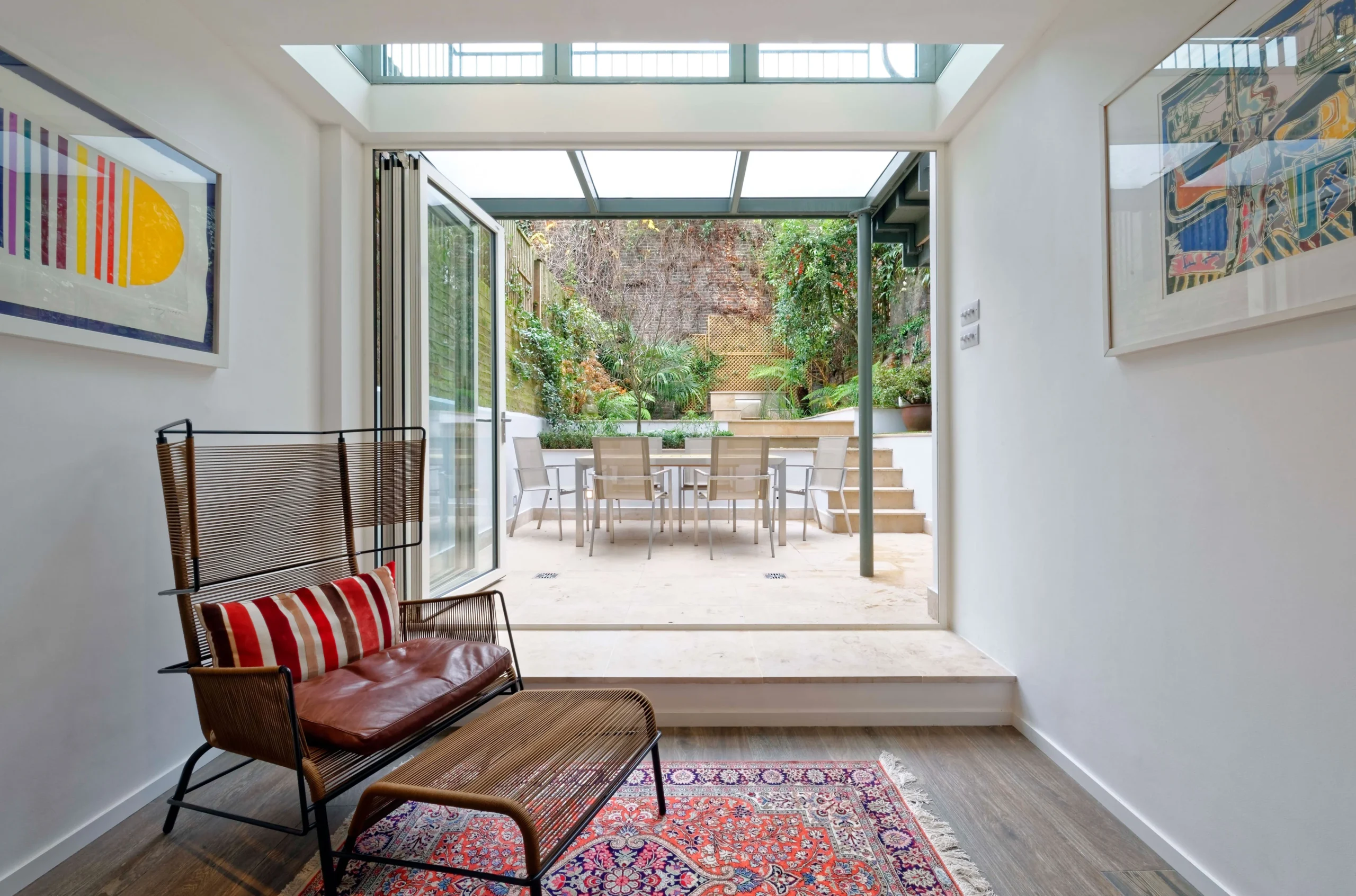
The dining area sits behind it and opens through bifold doors onto a raised terrace. Between the two levels is the floating glass staircase. The treads are cantilevered from the wall with nothing visible beneath them and lit from within, so the stair carries light down into the new level instead of blocking it. A solid staircase would have taken back a good part of what the excavation gained.
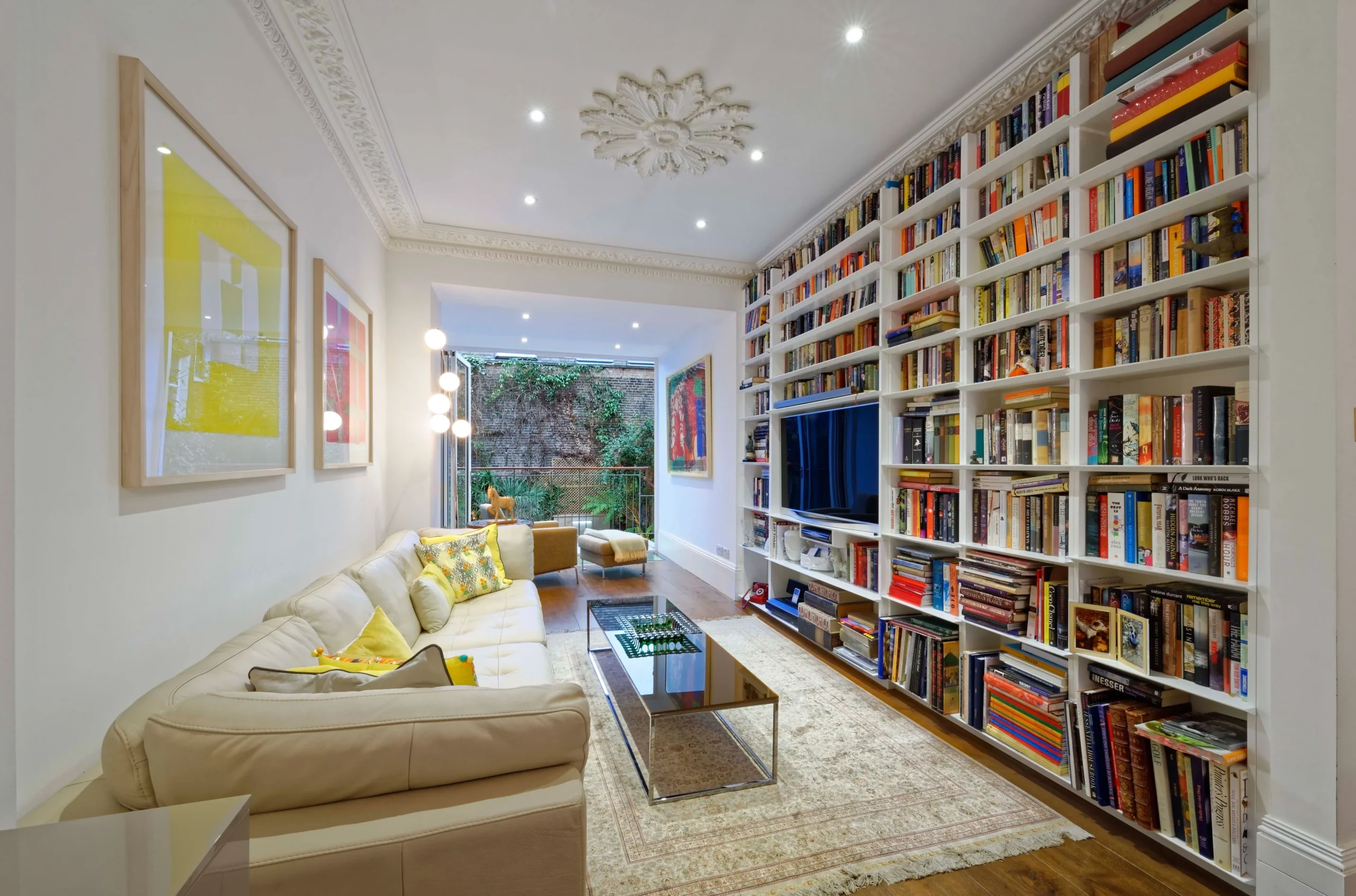
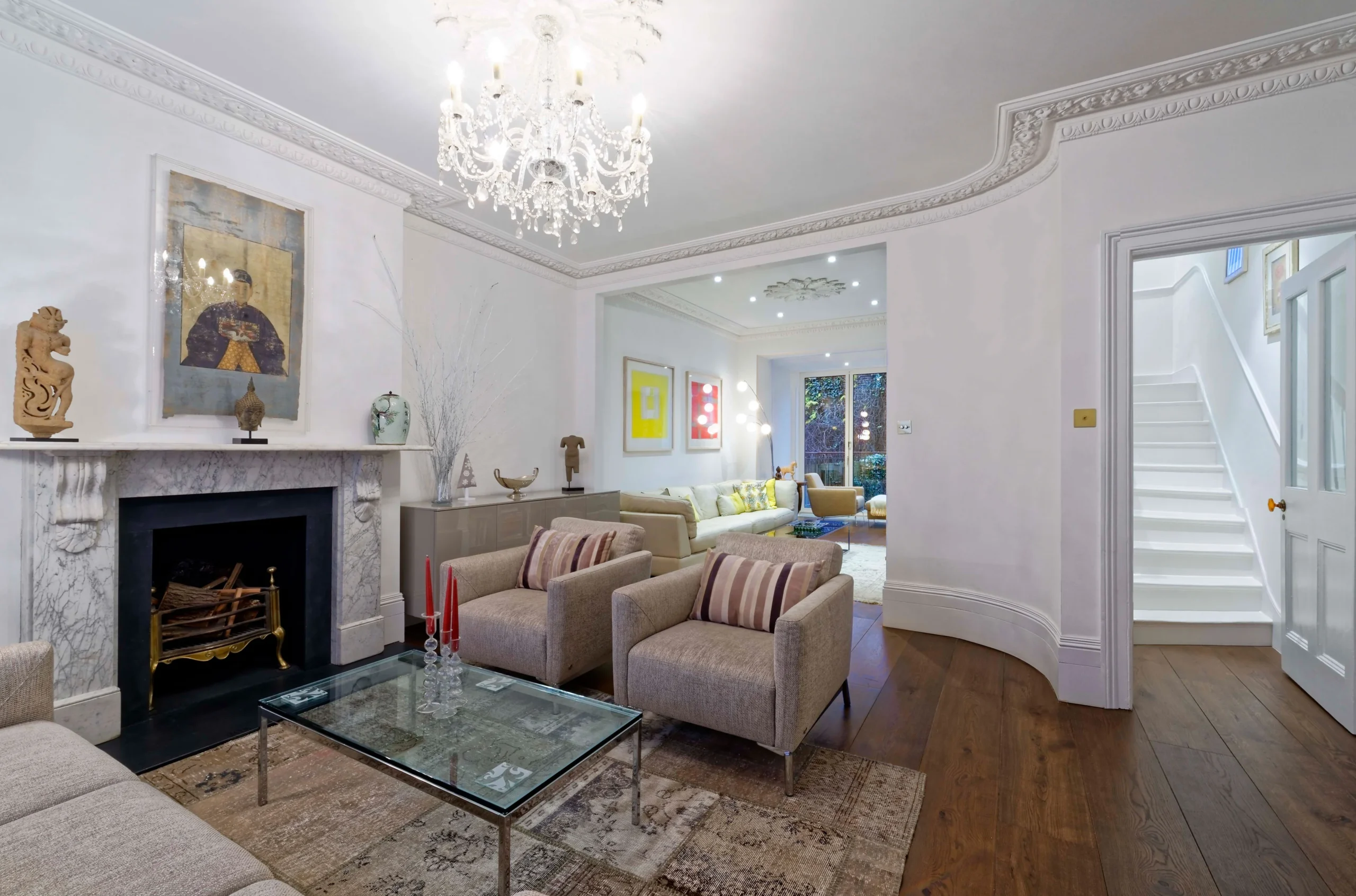
Upstairs the house is left as a period house. Ornate cornicing and ceiling roses are retained through the reception rooms, along with the carved marble fireplaces and a curved wall on the ground floor. The floor is wide-plank dark oak. In the snug a full-height joinery wall runs the length of the room and holds the books and the television, so the shelving reads as part of the room rather than as furniture pushed against it.
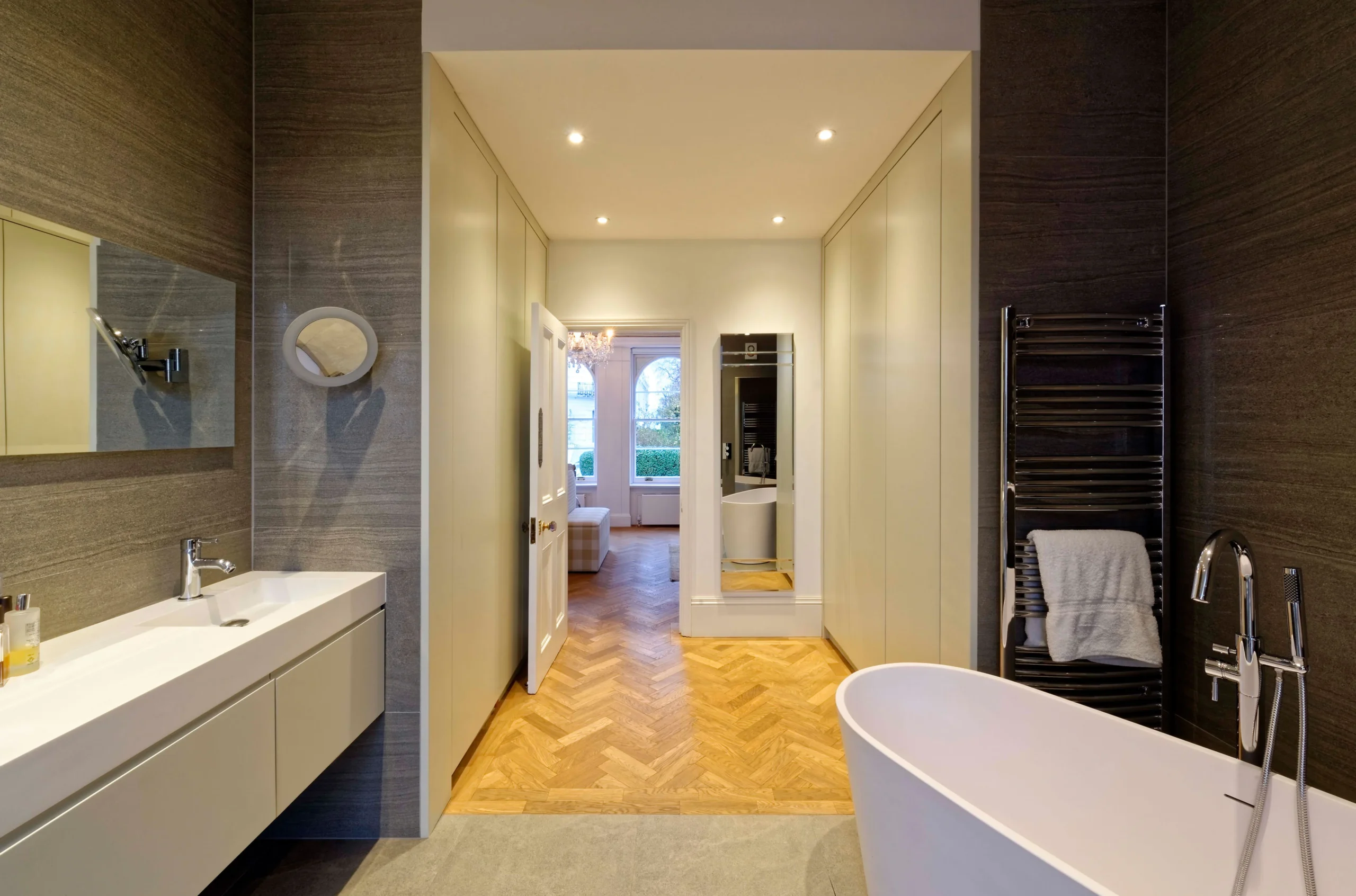
The principal bedroom keeps its marble fireplace over herringbone parquet. Beyond it the bathroom has a freestanding bath, a long vanity with an integrated basin, and a dressing corridor of fitted joinery linking the two.
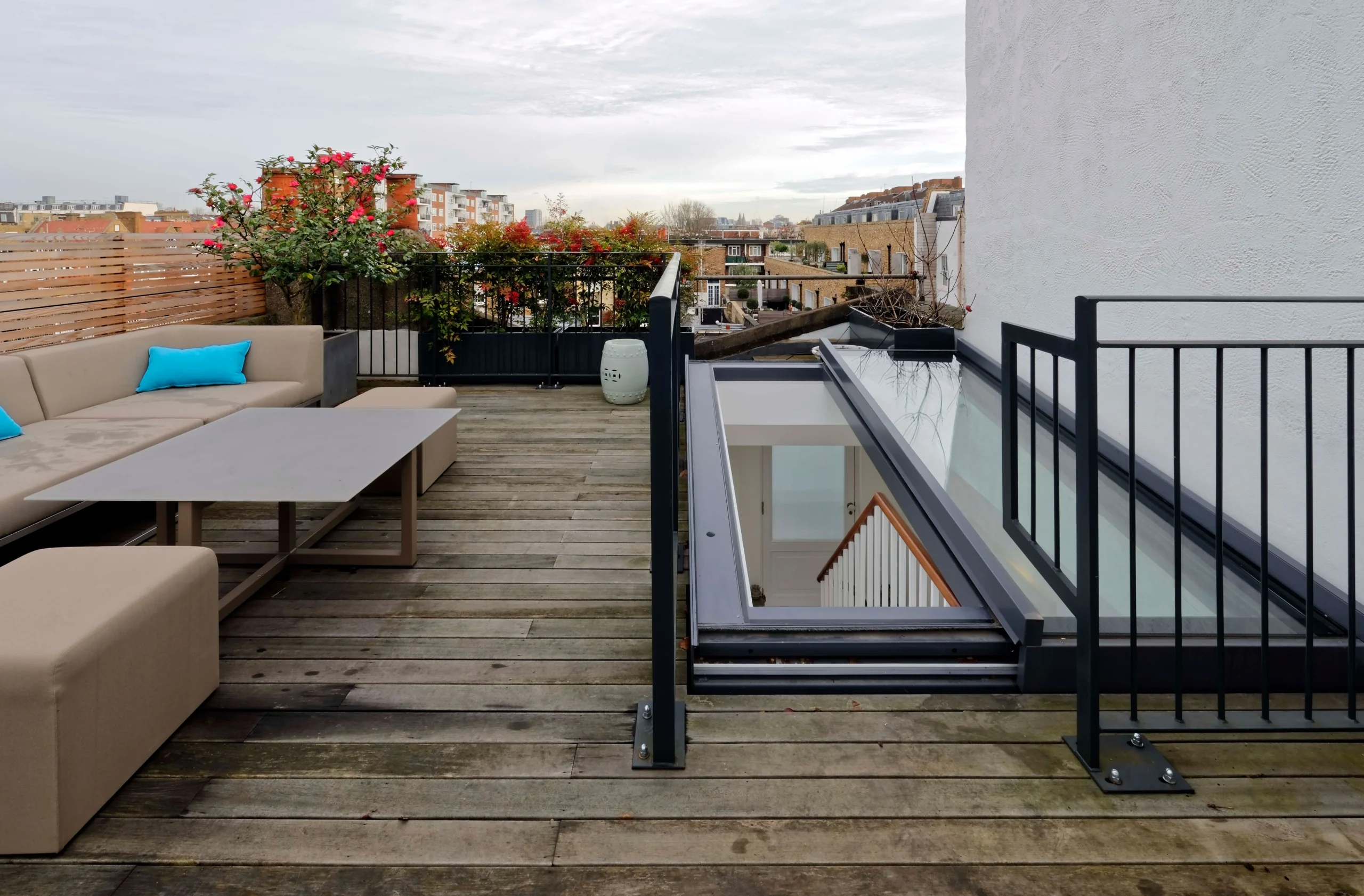
At the top of the house a sliding rooflight opens onto a roof terrace with timber decking, planted troughs and seating. The stair below rises to daylight rather than to a landing.
The house was fully rewired and reheated as part of the same programme, and the exterior landscaping was carried out alongside it.

Renovating a house in Notting Hill
What Notting Hill houses are like to work on
Most of W11 is stucco-fronted terraces and Victorian townhouses, with mews houses on the smaller streets and larger properties around the garden squares. Rooms are tall, plasterwork is often original and worth keeping, and a lot of houses already have a lower ground floor that is doing very little.
That last point is why so much of the work here goes downwards. Extending outwards is usually not an option, and the space beneath the house is already partly there. Whether yours is worth digging out comes down to the existing headroom, the ground conditions and how daylight is going to reach it. Those three questions are worth answering before anything is drawn, because the answer to the third one decides most of the design.
Conservation areas & permitted development
Internal work on a house that is not listed does not need planning permission. Building regulations still apply, but you are not waiting on the council to start.
Almost anything external does need it. Most of Notting Hill sits inside a conservation area, which removes permitted development rights that would apply automatically a few miles east. Windows, front doors, boundary walls and roof coverings are all controlled on many streets here.
Basements are their own case. There is no permitted development route for one anywhere in the borough, so every basement needs a full application, and they are limited to a single storey deep. A neighbour who dug one years ago is not a guide to what you can do now.
Party wall & access
The terraces share walls, so the Party Wall etc. Act 1996 applies to most structural work and to every excavation. Notices go to each neighbour, and if one dissents, surveyors are appointed before anything starts. It is routine, and it takes weeks, and it is much easier when it sits in the programme from the beginning rather than surfacing halfway through.
Streets here are narrow and parking is controlled, so deliveries, plant and skips have to be planned rather than assumed. On an excavation the spoil volume alone is a logistics question, and it is one of the reasons a Notting Hill job takes longer than the same job elsewhere.
What a house renovation costs in Notting Hill
A full renovation of a house in Notting Hill runs between £150,000 and £750,000, or roughly £2,000 to £4,000 per square metre.
Partial work costs considerably less. A single floor reworked, or a kitchen and bathrooms replaced without touching the structure, sits well below that range, and doing a house in stages is a common way to approach a period property.
What moves a project through that range:
- Digging out a basement or lower ground floor: £2,500 to £4,500 per square metre, higher than the rest of the house because of the underpinning and the waterproofing behind the finish.
- Kitchen: £35,000 to £90,000, depending on whether the units are made for the room or taken from a range.
- Bathrooms: £15,000 to £45,000 each.
- Structural work: £10,000 to £22,000 per opening to remove a load bearing wall, install steelwork and make good around it.
- Joinery: usually the largest single variable, and usually the reason a finished house reads as considered rather than assembled.
- Period fabric: rewiring, replumbing and replastering behind retained cornices and mouldings, and repairing original joinery rather than replacing it. Usually the item that surprises people.
These are planning ranges rather than quotes. What yours costs depends on the house, and that needs a visit before anyone can put a real number on it.

How long it takes
A full house renovation in Notting Hill usually runs six to nine months on site. With a lower ground floor excavation, as on this project, twelve to eighteen months is more realistic. Excavation, underpinning and waterproofing happen in sequence and cannot be sped up by putting more people on site.
Where the work needs planning permission, add a few months in front of that before anything starts. On an excavation it is worth going through pre-application advice first, because objections surface while the drawings can still change cheaply.
How we work
On this project the house was being dug out underneath while original plasterwork was being protected above it. Those two jobs run at the same time and pull in opposite directions, and what holds them together is sequencing rather than good intentions.
Van Peake runs the whole job with one team, from excavation and structural work through joinery and finishing.
We work on residential projects across London, from single rooms to whole houses. Our house renovation page covers the process in more detail. We also cover house renovations in Fulham, a short way south.

Common questions
What does a house renovation cost in Notting Hill?
Full house renovations run from around £150,000 to £750,000 and above, or roughly £2,000 to £4,000 per square metre. Digging out a basement or lower ground floor runs higher, at £2,500 to £4,500 per square metre, because of the underpinning and the waterproofing behind the finish.
How long does a house renovation take in Notting Hill?
Six to nine months on site for a full renovation. Twelve to eighteen months where a lower ground floor is being dug out, because excavation, underpinning and waterproofing happen in sequence and cannot be sped up by putting more people on site. Planning adds a few months in front of that where the work is external.
Do I need planning permission to renovate a house in Notting Hill?
Internal work to a house that is not listed does not need permission, though building regulations still apply. Almost anything external does, because most of Notting Hill sits inside a conservation area. Basements always need a full application and are limited to a single storey deep.
Can I live in the house during a renovation?
On a focused project, sometimes. On a full renovation involving structural work or excavation, no. We will tell you which yours is at the quote stage rather than once the work has started.
Do you only work in Notting Hill?
No. We work on residential projects across London. Notting Hill is one of the areas we have completed projects in, alongside Kensington, Camden, Clapham and Battersea.
Start your project
We take on residential projects of all sizes across London, from a single room to a full house renovation. Whether you are still working out what is possible or you know exactly what you want, please get in touch and we would be more than happy to talk it through with you.
Call 020 3503 1158 or email hello@vanpeake.co.uk
Contact Us